EEG system prices: what drives the cost?
EEG system prices depend on channel count, electrode type, software licences, triggering hardware and services: what to know before you ask for a quote.
Published
EEG system prices depend not on the label of a single product but on the whole that is assembled around a research question: the channel count, electrode type, amplifier, software licences, triggering hardware, consumables, and the installation, training and support services. This guide explains which items drive the cost of research EEG systems, which kinds of study each class of device suits, how a project budget is planned, and what information a quote request needs. It gives no figures: in research EEG there is no meaningful price independent of the configuration, and Nevosa does not publish prices on the site but shares them in a quote prepared for your needs.
Why does research EEG have no single list price?
A research EEG system is less a single product sold as it comes out of the box than a configuration. Of two systems built on the same amplifier family, one may be prepared for an 8-channel motor imagery study and the other for a 64-channel event-related potential (ERP) study; their caps, electrodes, software modules and trigger connections differ. That is why a search for an “EEG price list” so often leads nowhere: the items on such a list can only be defined once the research question and the experimental set-up are known.
Nor does the cost of a system consist of hardware alone. The licensing of the recording and analysis software, the synchronisation between the experiment computer and the stimulus presentation software, the initial installation, user training, the warranty period and the consumables needed in later years together make up the total cost of ownership. Basing the purchase decision on that total gives a sounder result than looking only at the first invoice. EEG publication guidelines (Keil et al., 2014) also ask authors to report recording details such as the channel count, reference, sampling rate, filters and impedance; each of those details is also a configuration decision.
The items that drive the cost
The table below summarises the items that most affect the cost in research EEG quotes and the question to settle for each. Not every item appears in every quote; your experimental design decides which ones are needed.
| Item | What it affects | Question to settle |
|---|---|---|
| Channel count | Amplifier modules, cap and electrode count, preparation time | How many channels does the research question need; will channels be added later? |
| Electrode type (wet, dry, active) | Signal quality, preparation time, consumables, participant comfort | Will recordings take place in the lab or in the field; is gel acceptable? |
| Amplifier resolution and noise | Reliable measurement of small potentials and slow components | What input noise, sampling rate and input range are needed? |
| Wireless or wired connection | Freedom of movement, battery life, data transfer, synchronisation method | Will the participant walk, do sport or be in virtual reality? |
| Real-time processing and BCI software | Whether closed-loop, neurofeedback and BCI experiments can be run | Is offline analysis enough, or is online feedback needed? |
| Software licences | Number of users and computers, updates, additional toolboxes | Is the licence perpetual or time-limited; how many users does it cover? |
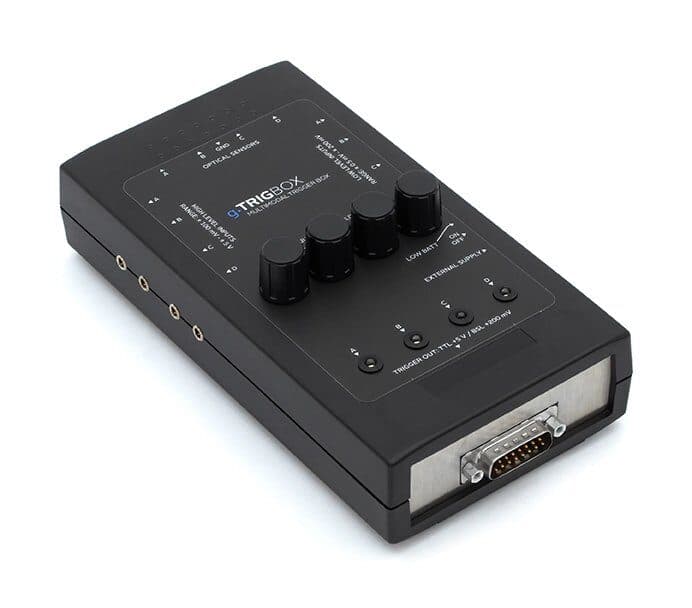
| Triggering and synchronisation hardware | Accurate marking of stimulus onsets in the data, a common clock with other devices | Which software will present the stimuli; will eye tracking, fNIRS or biosignals be recorded alongside? |
| Accessories and consumables | Caps for different head sizes, gel, electrodes, cables, cleaning supplies | How many cap sizes and how much consumable material per year? |
| Installation, training and support | Correct use of the system from day one, prevention of data loss | Are on-site installation, training for how many people and which support channel included? |
| Warranty | Additional cost and waiting time in case of a fault | How long is the warranty, what does it cover, where are repairs done? |
| Import and exchange rate | Quote validity, delivery date and budget plan | In which currency is the quote, how long is it valid, what is the delivery time? |
Channel count and electrode type often make the biggest difference, but on their own they do not determine data quality. Kappenman and Luck (2010) showed that low-frequency noise increased at high-impedance electrodes and that, especially in warm and humid recording environments, more trials were needed to reach statistical significance for P3 amplitude. In other words, a configuration that looks cheap may raise the total cost of a project by requiring longer sessions or more participants; the recording environment and the analysis plan should be considered together when choosing the electrode type.
Classes of device by use
Thinking of the EEG devices on the market in four rough classes makes it easier to see which one suits your research. The boundaries are not sharp, and the same manufacturer may offer products in more than one class. The table shows not cost but what each class suits and where it falls short.
| Class | Typical features | Suited to | Limit to watch |
|---|---|---|---|
| Consumer headband | A few dry electrodes, app-centred software | Demonstrations, outreach events, personal experimentation | Access to raw data, electrode positions and synchronisation are often limited; generally unsuitable for research meant for publication |
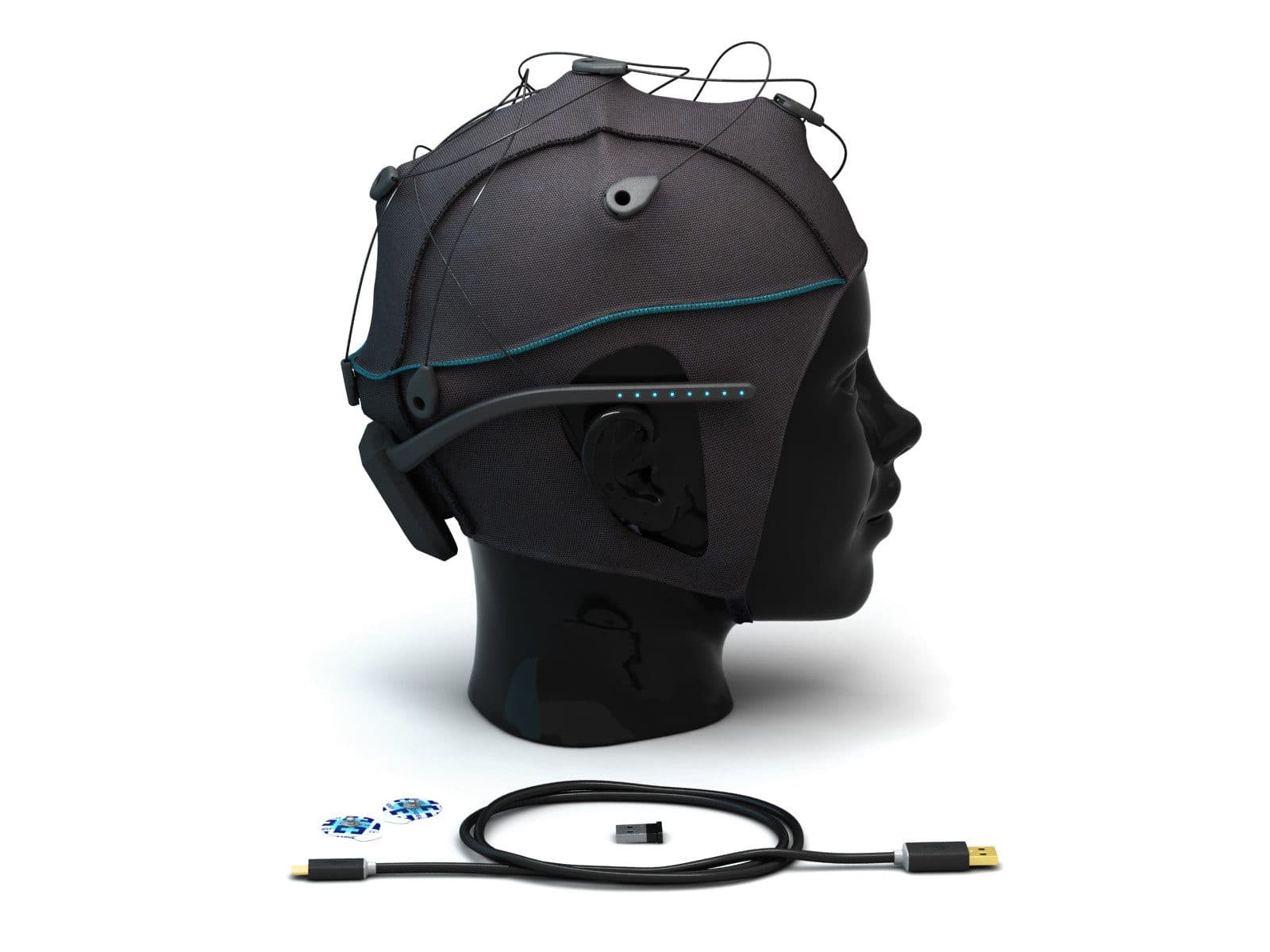
| Research headset | A limited number of channels at fixed positions, dry, hybrid or gel electrodes, wireless connection, raw data access | BCI teaching, student projects, teaching labs, pilot studies | Channel positions may not be changeable; insufficient for high-density mapping |
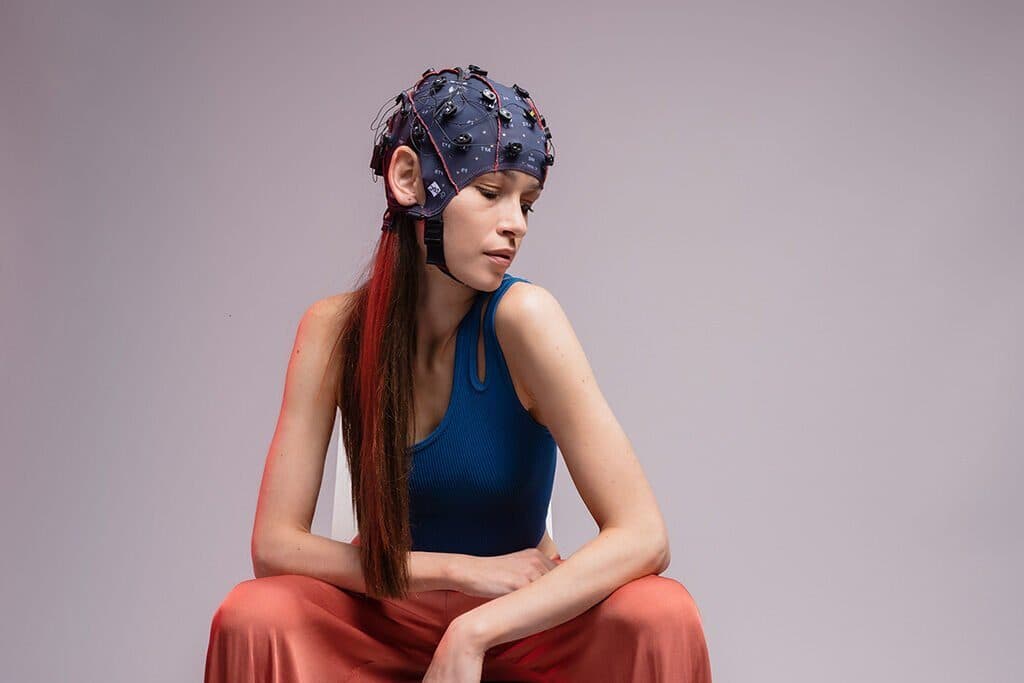
| Mobile research system | Wearable amplifier, interchangeable cap and electrode layout, wireless recording, trigger input | Recording in the field, on the move, in virtual reality or in sport; neuromarketing and user experience studies | Wireless synchronisation and battery life need separate planning |
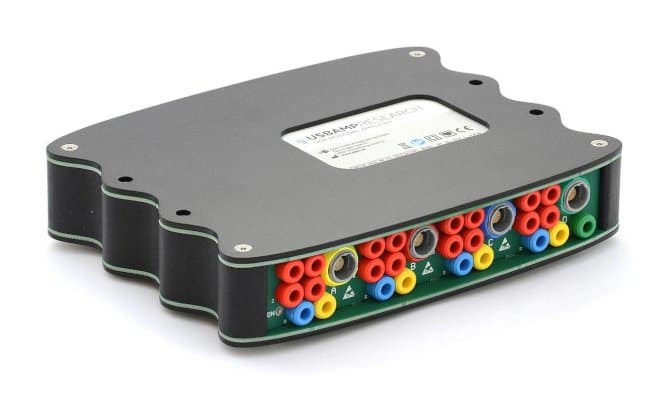
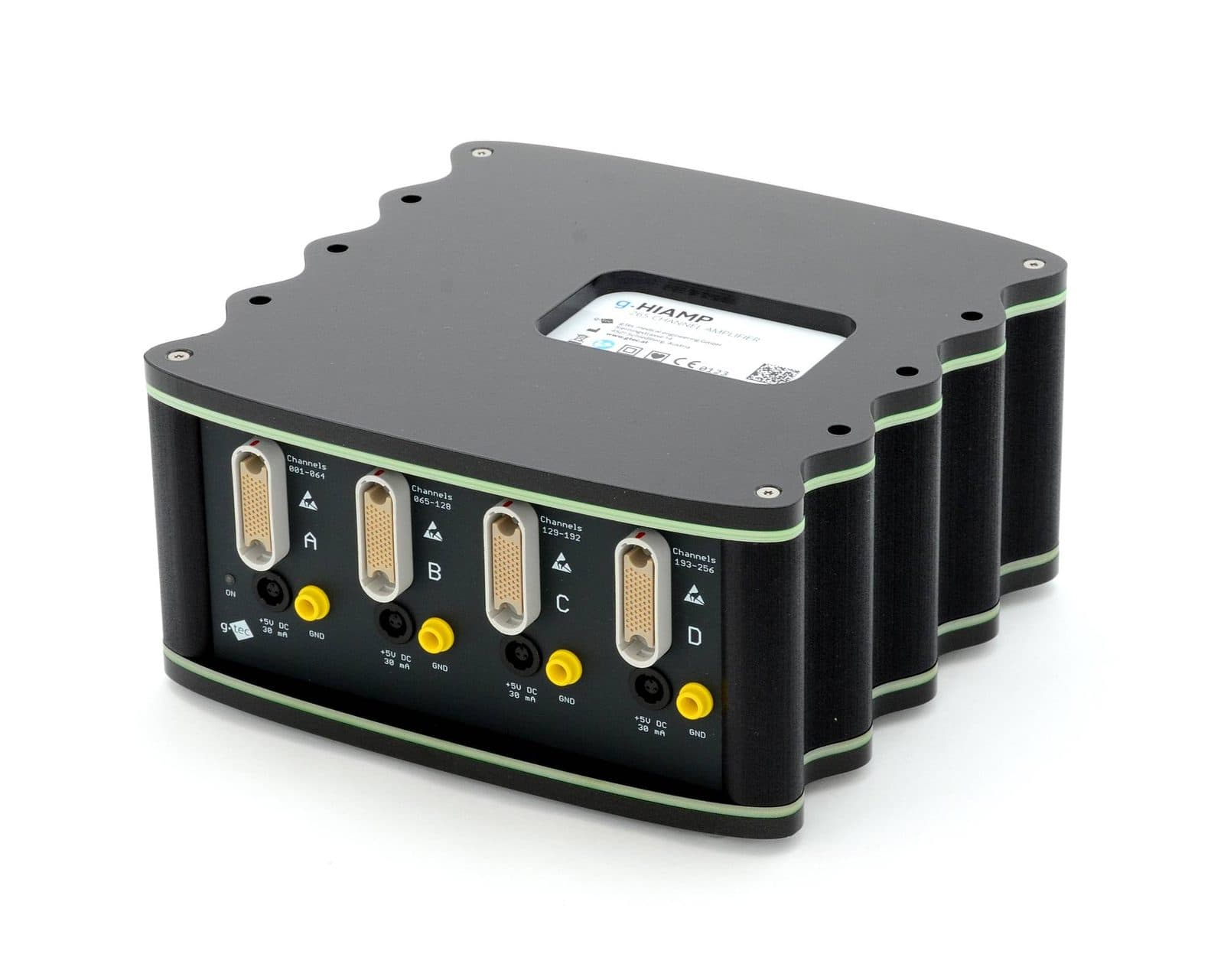
| Laboratory system | Amplifier scalable to high channel counts, many auxiliary inputs, advanced triggering | High-density ERP, source analysis, EEG recorded with TMS, tDCS or fNIRS, multimodal labs | Higher demands on space, preparation time and training |
The right class is chosen by working backwards from the research question. A few well-placed channels may be enough for teaching SSVEP or P300 BCI, whereas an ERP study aiming at source analysis needs a high-density cap. Moving up a class does not always give a better result: a laboratory system can mean a set-up too heavy to use in the field, and a consumer headband may not deliver the raw data and timing accuracy a peer-reviewed publication needs. When looking into the price of a portable EEG system, first settle the movement and environmental conditions of the recordings; portability is found both in research headsets and in mobile research systems, but their channel layouts and flexibility differ.
Clinical EEG devices are a different category
A large share of searches for an EEG device price concern the clinical EEG devices used in hospitals. Clinical EEG, video-EEG and polysomnography systems are medical devices used for diagnosis: they undergo conformity assessment under medical device regulations, are bought through hospital tenders, and their recordings are interpreted by a specialist physician. Research EEG systems, by contrast, are designed for flexibility in experimental design, full access to raw data and synchronisation with other devices; some are explicitly labelled “for research use only” by their manufacturer.
The two categories should not be compared in the same table. A research system cannot be used for clinical diagnosis, and a clinical device may not always offer the flexibility a researcher needs, such as triggering, real-time data streaming or open file formats. Where an EEG is needed for clinical purposes, the assessment should be made together with the physician and the hospital’s biomedical engineering unit. The same distinction applies to searches for EEG EMG system prices: clinical EMG and nerve conduction devices form a separate class, whereas in research, muscle activity is often recorded on the auxiliary channels of the EEG amplifier or with a separate biosignal system, on the same timeline as the EEG.
Buying a second-hand EEG system
A second-hand system may look affordable at first sight, but in research EEG the hidden costs are many. Before buying, get written answers to these questions:
- Can the software licences be transferred, or are they tied to the original buyer or to a specific computer?
- Do the drivers and recording software run on current operating systems; does the manufacturer still update this model?
- Is the warranty still valid; does the manufacturer or an authorised service provide maintenance and repair?
- What condition are the caps, electrodes and cables in? Worn electrodes and broken cables directly reduce signal quality.
- Are accessories such as trigger cables, chargers and auxiliary sensors complete?
- When was the device last checked or serviced, and is there a record of it?
Negative answers to some of these questions can mean that the low purchase price is soon exceeded by the cost of new licences, spare parts and repairs. For purchases made with public funds, also check with your institution’s procurement unit in advance whether buying second-hand equipment is possible at all.
Project budgets: TÜBİTAK and BAP
In Türkiye, a large share of research EEG purchases is funded through TÜBİTAK projects and through the Scientific Research Projects (BAP) units of universities. Because programme rules can change, the information below was checked on TÜBİTAK’s own pages on 1 November 2026; always read the current call text before applying.
- TÜBİTAK 1001
- The project duration is at most 36 months. According to TÜBİTAK’s page, as of the first call period of 2026 the upper limit of project support, including scholarships and excluding the project incentive bonus and the institution’s share, is 3,000,000 Turkish lira, with no annual budget limit. The same page states that requests for machinery and equipment are expected to be balanced with the total budget and that projects aimed at building infrastructure are not supported.
- TÜBİTAK 1002-A Rapid Support Module
- It is intended for short, small-budget research needs and for projects within a doctoral thesis. The project duration is at most 12 months; as of 1 February 2026 the upper limit of project support, including scholarships, is 150,000 Turkish lira a year. Applications based on equipment breakdown or on maintenance and repair costs fall outside the module’s scope.
- BAP projects
- Each university’s BAP coordination unit sets its own regulations, project types and budget limits. Small equipment purchases can also be made this way; since the rules differ from one university to another, consult your own institution’s current regulations.
When planning the budget, keep three points in mind. First, the equipment item should be tied to the scientific rationale of the project: the budget justification should state clearly which experiment needs which channel count and which software. Second, consumables, software licences and training should be treated as separate items; the gel, electrodes and caps needed over the course of the project should not be forgotten. Third, prices that depend on the exchange rate can change between the application and the purchase; note the date and validity of each quote and plan the purchasing schedule together with the project schedule. For purchases with public funds, also bear in mind that the contracting authority sets an approximate cost through price research of every kind (Public Procurement Law No. 4734, Article 9), and that quotes may therefore be requested from more than one supplier.
What to share when you ask for a quote
For a suitable quote to be prepared, the supplier needs to understand your research. Sharing the following information in your first message avoids needless back-and-forth and incompletely configured quotes:
- Research question: what do you want to measure (ERP, spectral power, BCI, neurofeedback, hyperscanning and so on)?
- Channel count and regions: the whole head or specific regions; is there a plan to expand later?
- Paradigm: how and with which software will stimuli be presented, and how many distinct event codes will be needed?
- Environment: laboratory, classroom, field, virtual reality or recording on the move?
- Accompanying measurements: will eye tracking, fNIRS, EMG, ECG, EDA or stimulation methods such as TMS and tDCS be used?
- Software: recording, offline analysis, real-time processing; do you need to work with MATLAB, Python or Lab Streaming Layer (LSL)?
- Users and training: how many people will use the system, and what level of training is needed?
- Budget timeline: the funding source, the application or purchase date, and the form in which the quote is needed (pro forma, technical compliance statement).
A quote prepared with this information contains not just a price but a configuration justified by your research. When comparing quotes, read each one item by item over the same scope: if one includes training and consumables and the other does not, the figures are not comparable. Nevosa prepares quotes on request for the EEG systems in its catalogue; you can send your details through the quote form.
Frequently asked questions
Why is no EEG system price given on the site?
Research EEG systems are configured by channel count, electrode type, software licences, triggering hardware and services, so two systems built on the same amplifier family can cost very different amounts. A meaningful price can therefore only be given once the research question and the experimental set-up are known. Nevosa does not publish prices on the site but shares them in a quote prepared for your needs.
What affects the price of a portable EEG system the most?
In portable and wireless systems, the cost is driven by the channel count, the electrode type (dry, gel or active), battery life, the wireless synchronisation solution and the recording and real-time processing software. If recordings will take place in the field or on the move, how event markers are written into the data should also be planned from the start.
What should I look for in a quote when buying an EEG system?
Check whether the quote lists hardware, software licences, accessories and consumables, installation, training, support and warranty as separate items. The licence term and number of users, the delivery time and the validity date of the quote should also be stated clearly. Comparing quotes only makes sense over the same scope.
What is the difference between a clinical EEG device and a research EEG system?
Clinical EEG devices are medical devices used for diagnosis; they are subject to medical device regulations, are bought through hospital tenders and their recordings are interpreted by a specialist physician. Research EEG systems are designed for flexibility in experimental design, access to raw data and synchronisation with other devices, and are not used for clinical diagnosis.
Can an EEG system be bought with a TÜBİTAK project?
The TÜBİTAK 1001 programme page states that requests for machinery and equipment are expected to be balanced with the total project budget and that projects aimed at building infrastructure are not supported. The equipment should therefore be an item that serves the scientific aim of the project and is defended in the budget justification. Read the call text of the current period for up-to-date limits and rules.
Does it make sense to buy a second-hand EEG system?
It can, but whether the software licences can be transferred, whether the drivers run on current operating systems, the warranty and service support, and the condition of the electrodes should all be confirmed beforehand. Shortfalls in these areas can lead to costs that soon exceed the low purchase price.
References and further reading
- TÜBİTAK · 1001 Scientific and Technological Research Projects Funding Programme (in Turkish)
- TÜBİTAK · 1002-A Rapid Support Module (in Turkish)
- Public Procurement Law No. 4734 · Legislation Information System (in Turkish)
- Kappenman and Luck (2010) · The effects of electrode impedance on data quality and statistical significance in ERP recordings, Psychophysiology
- Keil et al. (2014) · Publication guidelines and recommendations for studies using EEG and MEG, Psychophysiology