Skip to content
g.tec medical engineering · Amplifiers and electrodes

g.USBamp Research

16-channel biosignal amplifier

One of the most widely used biosignal amplifiers in BCI research. Simultaneous 24-bit recording from the brain, eyes, heart and muscles; real-time processing, an open software ecosystem and simultaneous recording with TMS, tDCS and fNIRS: for neurofeedback, closed-loop neuroscience and neuroprosthetics research.

  • 16 channels · 24-bit
  • 38.4 kHz sampling
  • 4 independent grounds
  • BCI2000 · OpenViBE · LSL
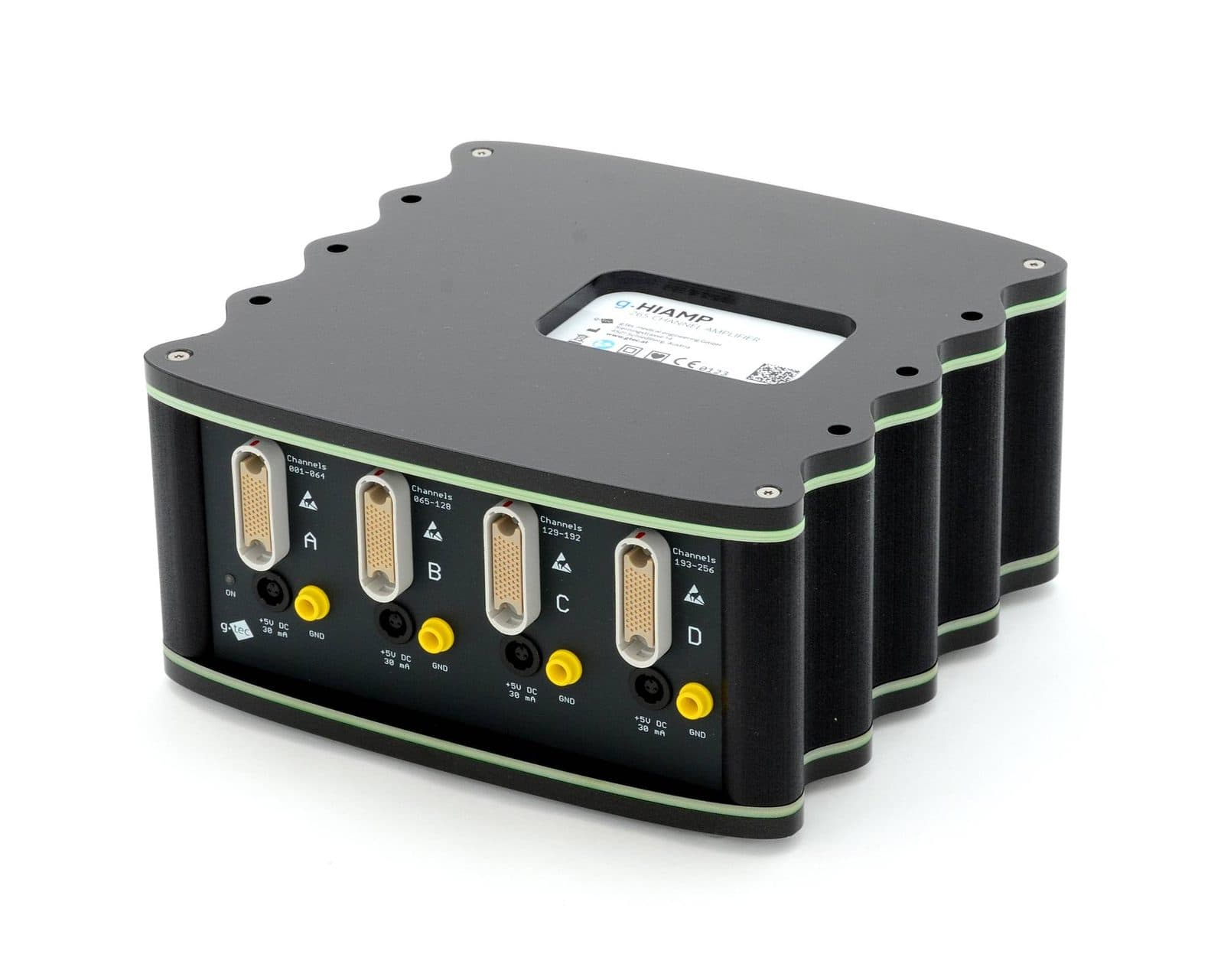
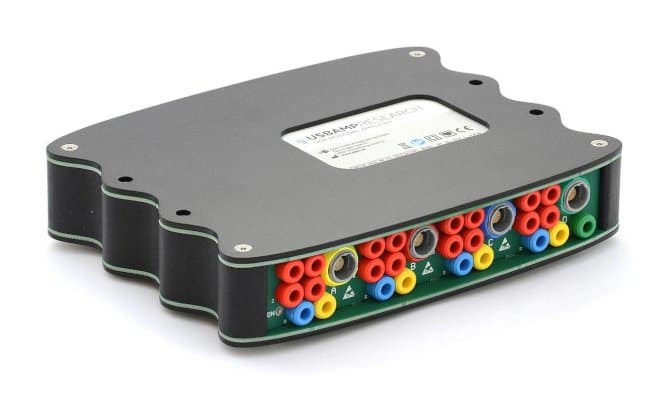
The g.USBamp Research amplifier: electrode inputs in four groups

Highlights

  • Real-time brain-computer interface (BCI) research and development
  • Neurofeedback, biofeedback and closed-loop neuroscience applications
  • Simultaneous EEG, EMG, ECG, EOG and physiological signal acquisition
  • EEG-TMS, EEG-tDCS and EEG-fNIRS integration
  • Functional brain mapping, neurophysiology and epilepsy research
  • Four independent grounds for interference-free recordings
  • Scales from 16 channels to multi-amplifier, high-channel-count configurations
  • Works with active and passive EEG electrodes and physiological sensors
  • Real-time processing with g.HIsys and Python integration through g.Pype
  • Open APIs for Python, MATLAB, Simulink, C, C# and .NET
  • Compatible with MNE-Python, FieldTrip, EEGLAB, BCI2000, OpenViBE and Lab Streaming Layer (LSL)
  • Machine learning, AI-based neuroscience workflows and reproducible research

Technical specifications

Channels
16 monopolar or 8 bipolar per device (selectable in software)
ADC
24 bit, simultaneous sampling across all channels
Sampling rate
Up to 38.4 kHz per channel
Amplifier type
True DC-coupled
Noise
< 0.4 µV RMS (1–30 Hz)
Input impedance
> 1000 GΩ // 220 pF
Sensitivity
85.7 nV · ±250 mV
Grounds
4 independent grounds
Signal processing
Integrated DSP for real-time filtering and preprocessing; internal digital band-pass and notch filters
Signal types
EEG, EMG, ECG, EOG, spikes and physiological signals
Sensors
Works with GSR, respiration, pulse, temperature, blood pressure, oxygen saturation and acceleration sensors
Size
197 × 155 × 40 mm
Weight
1,000 g
Interface
USB 2.0
Digital inputs
8 trigger inputs
Outputs
4 digital outputs · 2 × 12-bit DAC outputs
Calibration and testing
Built-in calibration unit; impedance checking for active and passive electrodes; internal test signals (sine, square, sawtooth, white noise)
Applied part
CF
Safety class
II
Real-time BCI

A standard in BCI research

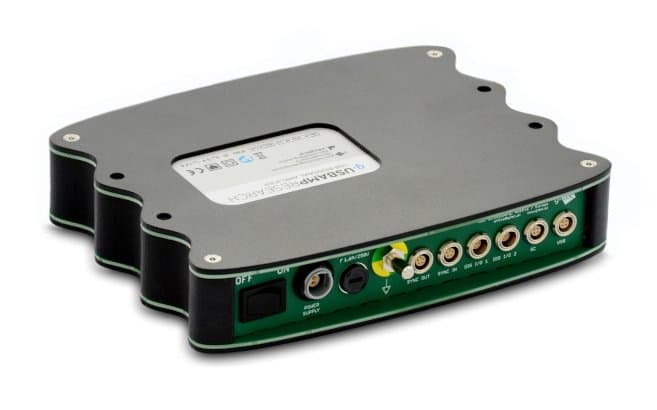
The back panel of g.USBamp Research: power, synchronisation, digital input-output and USB connectors

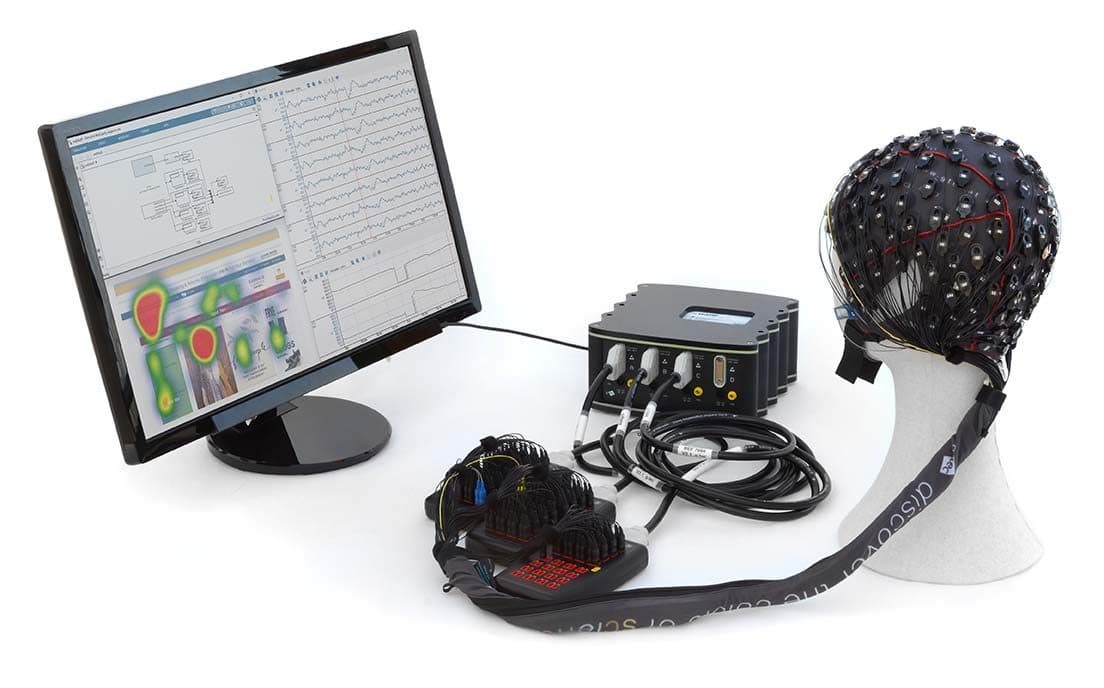
g.USBamp Research is one of the most widely used biosignal amplifiers in brain-computer interface research, and is used in neurofeedback, closed-loop neuroscience and neuroprosthetic applications too. With its low-noise architecture and real-time signal processing, several amplifiers can be synchronised; researchers develop their own algorithms with g.HIsys, g.Pype, Python, MATLAB and Simulink.

  • BCI
  • Neurofeedback
  • Closed loop
  • Neuroprosthetics
Open ecosystem

Work with your own tools

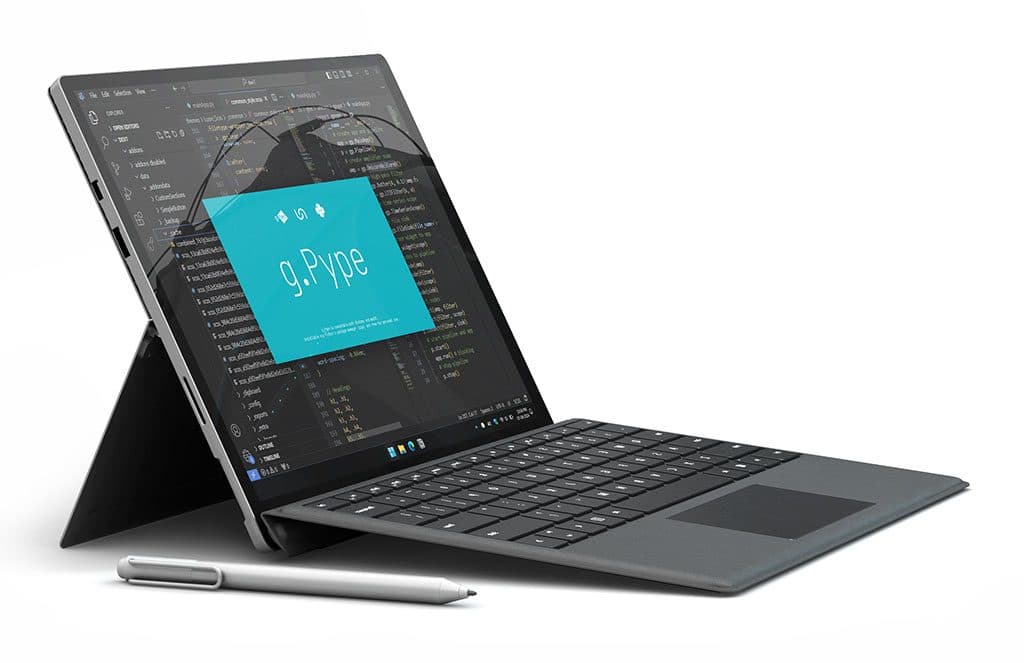
A tablet computer with g.Pype and Python code on screen

With g.Pype, g.HIsys, g.Recorder, g.BSanalyze and g.tec Suite 2024, researchers build brain-computer interfaces and record and analyse their data. g.USBamp Research works with MNE-Python, FieldTrip, EEGLAB, BCI2000, OpenViBE and Lab Streaming Layer (LSL), and synchronises with fNIRS, TMS, eye-tracking, motion-capture and physiological monitoring systems. Development in Python, MATLAB, Simulink, C, C# and .NET is supported.

  • g.Pype
  • g.HIsys
  • g.Recorder
  • g.BSanalyze
  • MNE-Python · EEGLAB · FieldTrip
  • LSL
Challenging conditions

DC-coupled, with a ±250 mV input range

The DC-coupled architecture combines a ±250 mV input range with a resolution of 85.7 nV, so large electrode offsets do not saturate the amplifier. That makes it suited to EEG-TMS, EEG-tDCS, slow cortical potentials, evoked potentials and peripheral nerve recordings.

  • ±250 mV
  • 85.7 nV
  • DC-coupled
Signal quality

One ADC per channel, validated before you record

Every input channel has its own 24-bit analogue-to-digital converter running at 2.4576 MHz; hardware oversampling combined with floating-point digital signal processing raises the signal-to-noise ratio, to under 0.4 µV RMS of noise between 1 and 30 Hz. An integrated signal generator (sine, square, sawtooth, white noise), automatic calibration and impedance checking, with continuous offset and gain compensation, validate the system before an experiment.

  • 2.4576 MHz ADC
  • < 0.4 µV RMS
  • Automatic calibration
  • Test signals
Scalability

From 16 channels to multichannel systems

A single device offers 16 monopolar or 8 bipolar channels (selected in software). Several g.USBamp Research units are synchronised into larger acquisition systems that keep simultaneous sampling and consistent timing, and can be split back into independent systems when needed.

  • 16 channels per device
  • Synchronised multi-device
  • Multi-device toolbox
Brain mapping

ECoG measurements

ECoG recordings can be made with Ad-Tech, PMT, Unique Medical and Cortec grid electrodes: a complete set-up for brain mapping procedures and neuromonitoring applications.

  • ECoG
  • Neuromonitoring
Success story

Cybathlon 2016: gold in the BCI race

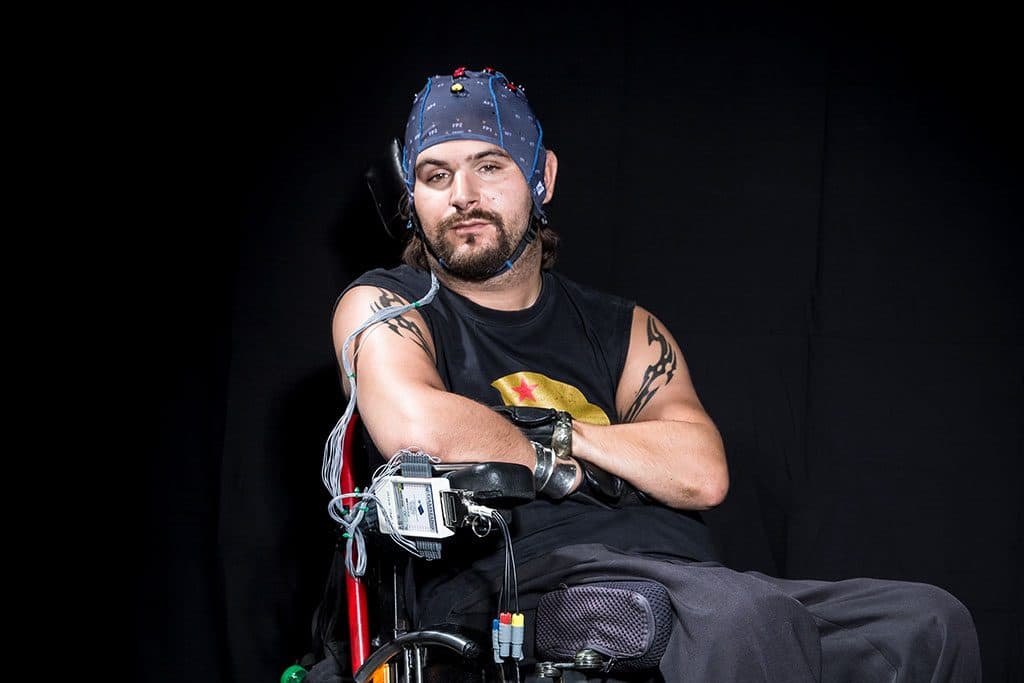
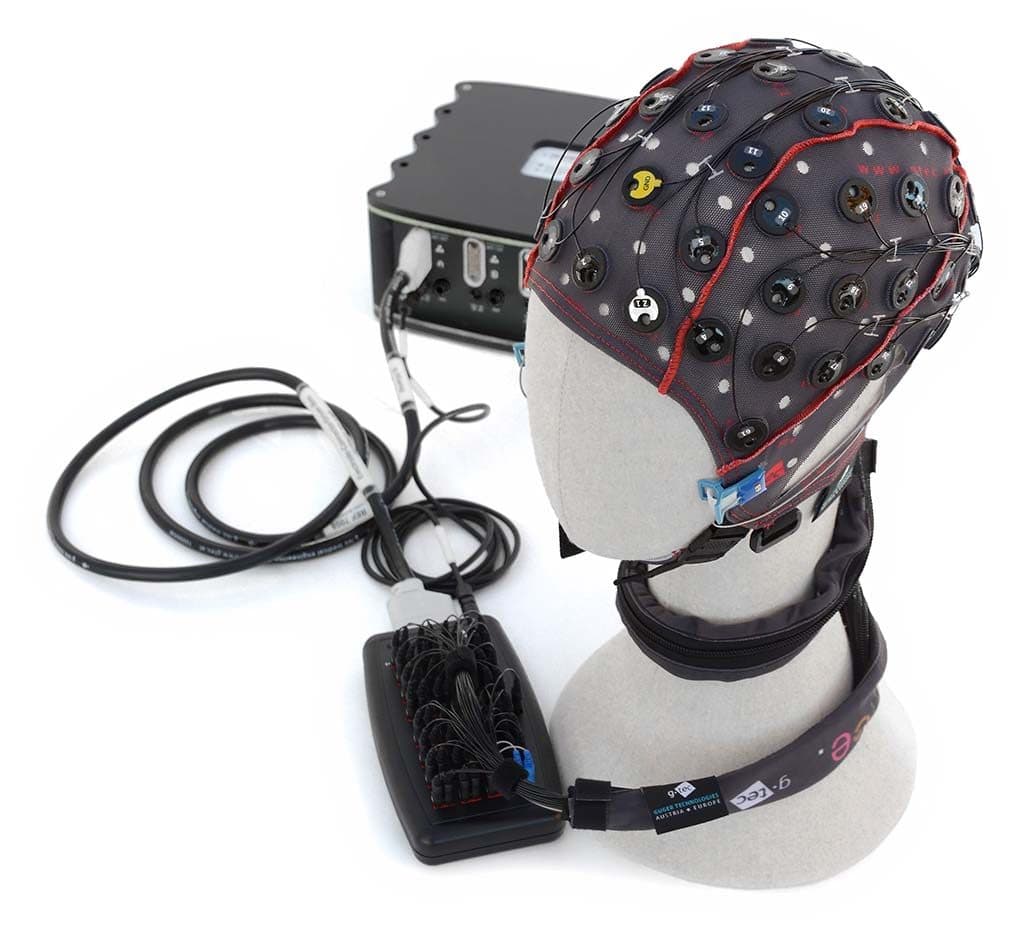
A Cybathlon pilot in a wheelchair, wearing an EEG cap

At Cybathlon 2016 the gold-medal team Brain Tweakers/CNBI-EPFL, with pilot Numa Poujouly from EPFL, posted the two fastest times on g.USBamp Research: 90 and 125 seconds (the next best was 135 seconds). The pilot controlled an avatar in the BrainRunners game with brain activity alone. A benchmarking study published in Frontiers in Neuroscience looked at 11 international BCI teams racing live with tetraplegic pilots, and reported that no amplifier gave a systematic edge overall: performance came down to pilot training.

  • Cybathlon 2016
  • 90 s and 125 s
  • 11 teams
Research

P300 BCI: validated with 100 people

In a study with 100 unselected participants, g.USBamp was used with 8 channels, 24 bits and 256 Hz sampling and a real-time, Simulink-based LDA classifier; calibration took 5 minutes. With the row/column paradigm, 72.8% of participants spelled with 100% accuracy.

  • 100 participants
  • 72.8% at 100% accuracy
  • 5 min calibration

Applications

g.tec
Contact

Let's plan your project together.

Talk to our team about device selection, protocol design, installation and software integration. We will work out the technical configuration that best fits your research or clinical goal.

Request a quote

Call us +90 554 381 46 20Serving all of Türkiye · reply within 24 hours on working days