What is eye tracking and how is it measured? From fixations to heatmaps
Learn calibration, fixations, saccades, areas of interest and pupil measures, with an animation of synchronised EEG and eye tracking.
What does eye tracking measure?
Eye tracking estimates where gaze is directed over time. Common video-based systems use pupil centres and corneal reflections; calibration relates these observations to screen or scene coordinates. Desktop trackers and wearable glasses support different task conditions. Looking at a location does not by itself establish attention, understanding or preference.
Calibration and acquisition
Calibration must be checked throughout a study. Changes in device position relative to the head or reduced accuracy may require validation and recalibration.
- Define the task, screen or scene arrangement and areas of interest.
- Position equipment and confirm the eyes can be tracked.
- Present calibration targets to the participant.
- Assess accuracy and data loss using separate validation points.
- Record timestamped stimuli and task events.
- Inspect missing samples, blinks and calibration drift.
- Extract fixations and saccades using documented algorithms and thresholds.
- Report AOI measures alongside sampling and data-quality information.
Which measures are available?
Fixation duration, time to first fixation, dwell time within an area of interest (AOI) and scanpaths are common outputs. Saccades are rapid gaze transitions. A heatmap summarises gaze distribution; recording duration and colour scales must be matched for comparisons. Pupil size is affected by illumination, viewing angle and physiological factors, so it should not be interpreted solely as mental workload.
Combining eye tracking with EEG
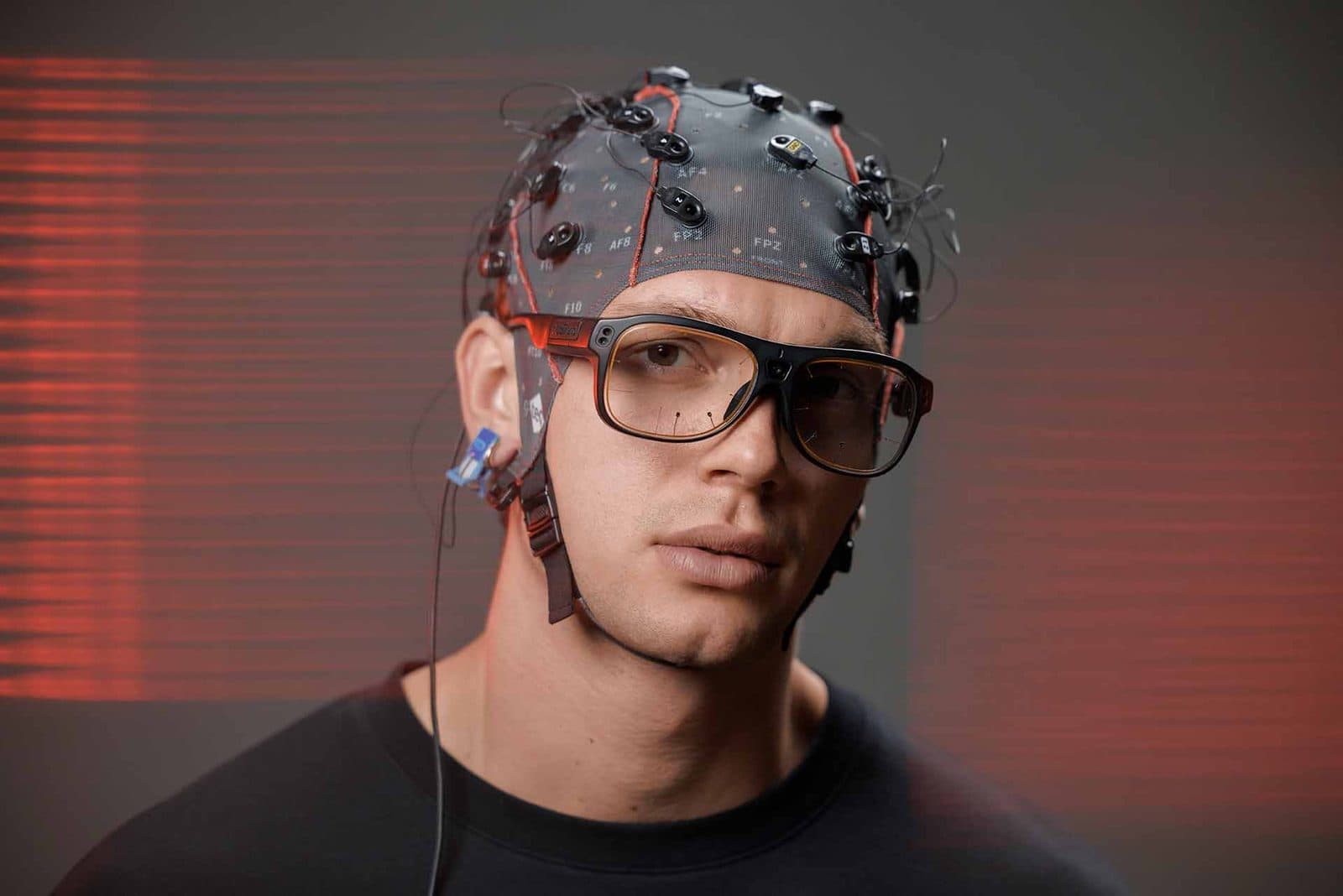
With synchronised EEG and eye tracking, fixation onsets can become EEG events for fixation-related potential analysis. Validate clocks, latency and drift, and assess EEG artefacts caused by eye movements. For eye tracking Turkey projects combining Tobii with systems such as g.Nautilus, plan calibration, movement conditions and a shared event stream together.
Explore the animation
Explore how eye cameras track the pupil and corneal reflections, and how fixations can be aligned with EEG recordings.
Where the eyes go, and how the brain answers
The glasses record what the participant looks at, the EEG how the brain responds to it. On one time axis, every look becomes a time mark in the brain signal. Switch the view, and tap the points in the drawing to see what each part does.
Infrared light makes small reflections on the cornea; eye cameras follow the pupil and these reflections, and where the gaze falls in the scene is calculated.
Each dot is one gaze sample: 100 Hz, one every 10 ms. EEG is recorded five times as often, 500 samples a second; both sit on one time axis.